The 6pm Shutter: What to Know Before Renting Above a Shop
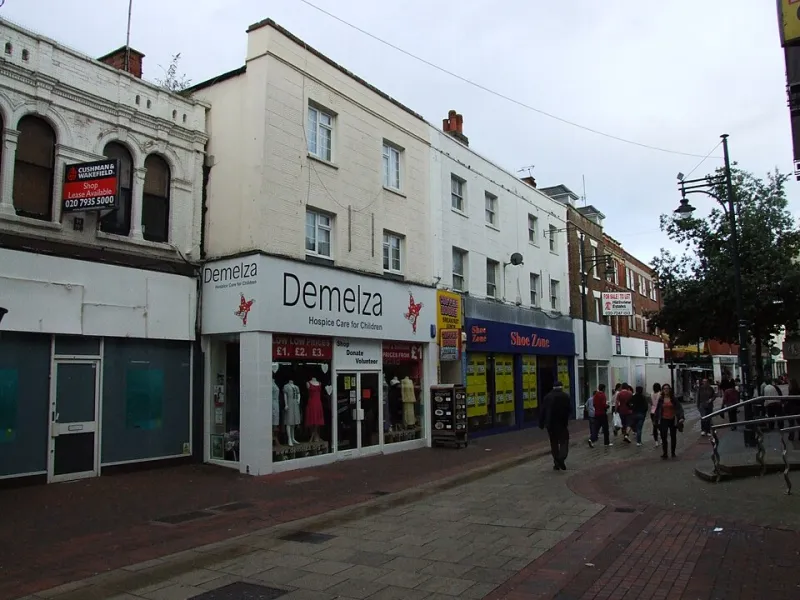
Photo: Chris Whippet , CC BY-SA 2.0, via Wikimedia Commons
Flats above shops are some of the best-value addresses in a UK town centre. They are often roomier than a new-build a street back, closer to the station, and above a bakery that makes the whole staircase smell like Saturday morning. They also come with a neighbour that never appears in the listing: the business underneath. Viewing one properly means looking down as much as you look around.
Treat the shop as your closest neighbour
When you view a flat, you are usually shown the front door, the kitchen, the bedroom and the boiler. Above a shop, the ground floor is part of the building’s daily life, even if it is not part of your tenancy. The shop’s opening hours, delivery rhythm and waste routine will land on your ceiling, your hallway and your sleep. That is not automatically a problem — plenty of people happily live over a florist, a barber or a quiet office — but it is worth checking before you sign rather than after the first 6am delivery.
Start by walking the street at the time you would actually be home. If you work from home, that means a weekday morning. If you are out until 11pm, it means a weekday evening. A Sunday afternoon viewing tells you almost nothing about a shop that opens at 7am six days a week.
Map the shop’s day onto yours
The most useful question is not ‘is the shop noisy?’ but ‘when is it noisy, and will I be there?’ A takeaway that hums quietly at lunchtime may become a different beast at 11pm on a Friday. A convenience store may have a delivery lorry at 5am and a stream of customers from dawn. A nail bar may be calm inside but have a queue on the pavement outside. None of these are deal-breakers on their own; they are just facts you want on the table.
Ask the agent for the commercial unit’s permitted opening hours. Then ask whether those hours have changed recently, or whether the business has applied to vary them. Your local council’s licensing register is a useful cross-check for late-night refreshment, alcohol or entertainment licences. It is public, it is dull, and it is exactly the sort of dull that saves you a year of interrupted sleep.
Follow your nose and your ears
Extractor fans are the great unseen feature of high-street flats. A bakery, a fried chicken shop or a curry house will usually have ducting running up the back of the building, and that ducting can be a source of smell, noise and vibration. Stand in the bedroom and listen. Then stand in the bathroom, the hallway and the room you plan to use as a study. Extraction noise can travel in strange ways through old buildings.
If you can, visit again while the shop is trading. Open the windows. Check whether the smell is a faint background note or something that will settle into your curtains. Look at the outside wall for grease staining near the extractor outlet. None of this needs to be dramatic — a well-maintained kitchen can be a perfectly good neighbour — but a flat that smells of last night’s fryer at 9am is telling you something.
The bin store is a shared office
Above a shop, waste is a shared responsibility and a common source of friction. Commercial waste and household waste often end up in the same rear yard or bin store, and the result can be overflowing bins, pests and a smell that arrives before you do. Ask the agent who is responsible for the bin store, how often it is collected, and whether the commercial unit has its own waste contract. Then ask the shop the same question. If the answers do not match, you have found a management gap worth understanding before you move in.
Fire doors, back doors and the route out
A mixed-use building needs a clear escape route. Check that the flat has a safe way out that does not depend on walking through the shop, and ask whether there is a fire risk assessment for the whole building. Look at the communal hallway: are the fire doors close properly, is the staircase clear, and is there a back door that actually opens? If the flat is accessed via a rear alley, visit it after dark. A route that feels fine at 2pm can feel very different at 10pm.
Questions worth putting in writing
Before you commit, email the agent with a short list. What are the commercial unit’s permitted hours? Who maintains the extractor and the bin store? Is the flat’s escape route independent of the shop? Are there any recent complaints about noise or waste? What does the service charge or building insurance cover, if either applies? A good agent will answer; a vague one is giving you information too.
Listing clues that should slow you down
Some phrases deserve a second look. ‘Mixed-use building’ is neutral but worth investigating. ‘Commercial premises below’ is not a red flag by itself, but it does mean you should ask what kind of commercial premises. A listing that has no exterior photo, or only a cropped shot of the front door, may be hiding a shuttered shopfront or a back-alley entrance. ‘Ideal for a professional who is out all day’ is sometimes just marketing, and sometimes a quiet admission about the noise. Read it as a prompt to ask more, not a reason to walk away.
A flat above a shop can be a brilliant home: high ceilings, big windows, a short walk to everything. The trick is to view the building as a whole. Stand on the pavement, look up at your future windows, and listen to what the street is telling you. If the shop’s day fits yours, you may have found a gem. If it doesn’t, you have saved yourself a very long year.